
Revenue Sharing for Modular Storage
UpSize
by Brad Hadfield, Modern Storage Media
In self-storage, unused land isn’t just empty space, it’s unrealized revenue. Expansion, however, requires capital, time, and risk many operators or investors can’t justify, especially at an underperforming property. UpSize, a new company that launched in Feb. 2026, has come up with a no-cost solution: a revenue-sharing platform for modular storage units.
Sizing Up The Situation
With a series of headwinds beginning to slow the booming self-storage industry, Tom de Jong, a founding member with Colliers Self-Storage Group, and Jake Glatzer, a managing partner with Acier Holdings, were finding the challenges mounting. De Jong was struggling to reach numbers that made sense for some clients to sell an asset. At the same time, Glatzer was facing less-than-rosy proforma projections for some conversion projects for developers that intended to build them, fill them, and sell them.
Their troubles were two sides of the same coin. De Jong needed to get the deals to pencil so his clients could find a buyer, and Glatzer needed stronger returns to position the properties for exit once they were stabilized.
“Jake and I had each considered trying to parcel out unused land and sell it or build RV and boat parking enclosures, but both options were time- and capital-consuming,” says de Jong. “On the other hand, we knew that there was a lot of demand for drive-up units, especially at properties that were composed mainly of climate-controlled interior units.”

Both men arrived at the same conclusion: monetize unused land by adding modular storage units. “This was the fastest way to move a property toward transactable value, or to where it would be in the near future.”
Of course, portable containers cost money too, and capital partners aren’t typically going to put more money into an underperforming property or one that isn’t expected to hit projections. But what if the containers were free?
That’s when de Jong and Glatzer got together, and with additional financial backing from real estate expert Morris Sarway, created UpSize—a revenue sharing model that would allow operators to add portables to their plot with no capital investment.
“There’s no downside to UpSize. You’re adding revenue without adding capital, and that changes everything.”
—Tom de Jong
Monetizing Land
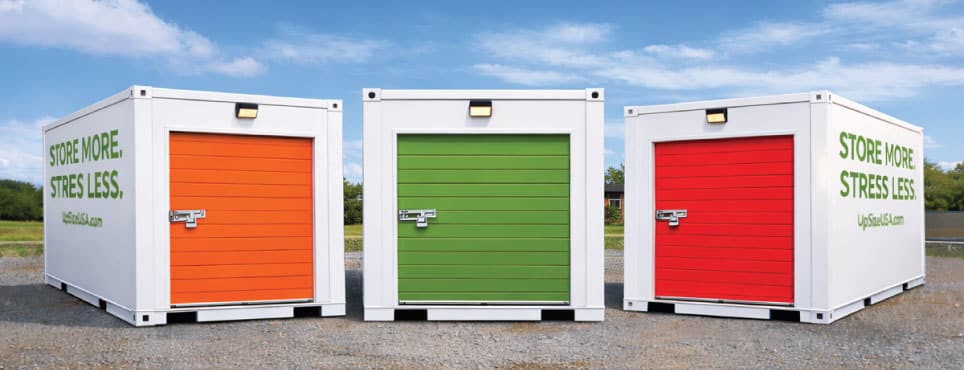
To help owners monetize unused land with no capital investment, UpSize provides modular, high-quality storage containers at zero cost, sharing revenue from day one. “We source our portables from reputable manufacturers like Boxwell,” says de Jong. “They benefit from making a sale and getting paid upfront, and we procure quality containers specifically designed for commercial self-storage facilities; they’re weather-resistant, secure, and come with built-in, high-grade locks. We can also match the containers to a facility’s color scheme so [that] they blend in seamlessly.”
Although UpSize launched less than three months ago, all the pieces are already in place. “Before we officially launched, we did four test sites to iron out any kinks and get all our ducks in a row. We wanted to be 100 percent ready to go the day the announcement was made.”
UpSize makes working with them completely hassle-free. Every deployment starts with a thorough site audit to make sure the property is a fit and the economics work. If it’s a go, the company then provides guidance on unit mix, looking at what customers need based on current occupancy levels, and pricing, based on rates for similar drive-up units in the market. There’s typically an eight- to 12-week lead time, and during that window UpSize takes care of permitting and obtaining approvals. When the product arrives, they do the installation. “We like to say, ‘You focus on running your facility while we expand your capacity,’” says de Jong. “Once we’re through, all you need to do is add them to your regular inventory and rent them up.”
As the operator begins earning money on the portables, so does UpSize, making it a true win-win. “We set each client up for success. We’ve invested in them, because the more they earn, the more we earn.” De Jong adds that despite the revenue share, all ancillary sales are for the operator to keep. “Locks, fees, protection plans, we take none of that income.”
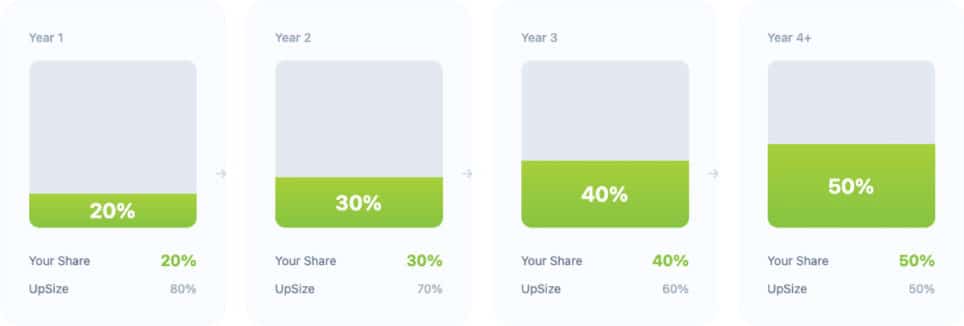
The revenue-sharing structure follows a declining scale for the first three years, and there’s a buyout provision in year three (See Revenue Share Model.). While it could be a perpetual deal—it would remain a 50/50 split beyond year four with a 10 percent discount per year capped at 20 percent—de Jong says it ultimately makes more financial sense for the operator to buy them out by year four. He also states that if the owner winds up selling the facility before they’ve purchased the units, UpSize simply takes the unit buyout number through escrow.
Dollars And Sense
De Jong believes Upsize is a smart solution for any owner or investor. “If you’re in this for the long haul and you’re 90 percent occupied or you’re completely sold out of certain unit sizes, this makes for an easy addition that generates more income,” he says. “Now, if the intent is to sell, every incremental dollar you bring in equates to entity value, so you can increase the value of a property by hundreds of thousands of dollars by adding square footage, making it worth that much more when you go to transact.”
“There’s no downside to UpSize,” says de Jong. “You’re adding revenue without adding capital, and that changes everything.”
For the complete article and additional insights, read Modern Storage Media’s original Innovation Spotlight on UpSize in the April 2026 issue of Messenger Magazine.