CLASS A HALLWAY SYSTEMS: A CASE STUDY

Across Australia, self-storage is evolving. Customers increasingly expect facilities that feel secure, modern, and professionally built, especially in major metro areas and high-growth suburbs. As a result, more developers are investing in indoor, climate-controlled storage environments that support premium pricing, long-term durability, and a better customer experience.
A critical component of any indoor facility is the hallway system.
A hallway system is the building’s internal steel structure: the roll-up doors, partition walls, and corridors that convert an open building shell into secure, rentable units. It directly impacts unit count, layout efficiency, build speed, and the overall look and performance of the finished facility. Simply put, it is the system that turns floor space into revenue.
This case study follows the development of a new Class A indoor storage facility completed in Flowery Branch, Georgia (USA). While the location is international, the project reflects the same priorities and challenges Australian developers face: fast build schedules, efficient unit layouts, and a high-quality finished product that performs for years.
THE PROJECT
The project was developed on a commercial-zoned site of approximately three acres, located within an established industrial park alongside several warehouse complexes. Within a short drive of the facility were residential neighbourhoods, local businesses, a university campus, and major recreational destinations. This mix made the location well-positioned for strong storage uptake.
PHASE I: PLANNING
Design + Layout
Once the property was secured, the building was designed as a three-storey indoor facility totaling 120,000 square feet (approximately 11,150 m²). The interior hallway system layout was engineered to maximise revenue-generating area while maintaining clean access and professional presentation.
The Final Plan:
910 rentable storage units
92,000 rentable square feet (approximately 8,550 m²)
Nearly 80% of the building dedicated to income-producing space
This is a key performance benchmark for developers, as hallway system design is one of the most important levers for increasing net lettable area.
Manufacturing & Takeoff
Boxwell reviewed the architectural drawings and produced a detailed hallway system takeoff. This process catalogues every component required to build the system, down to individual parts and fasteners. Because Boxwell manufactures its systems in-house, every component was cut to specification, inspected for quality, and packaged for efficient transport and installation.

PHASE II: DELIVERY + INSTALL
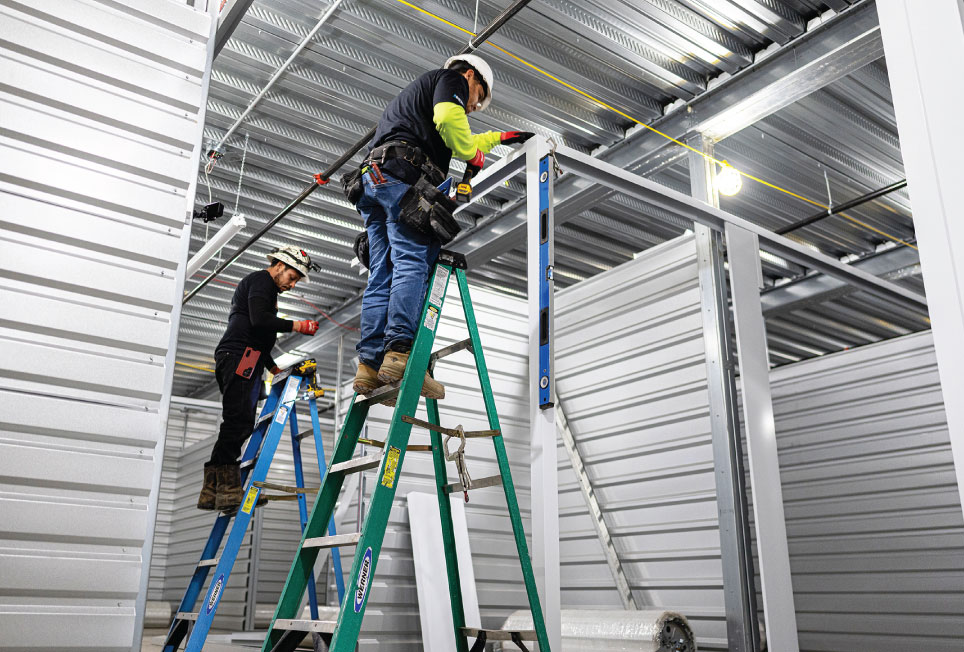
As the building’s exterior neared completion, the hallway system was delivered on-site and installation began immediately. Over the next two months, Boxwell’s installation team transformed the interior by installing the full system, including the 910 units, along with hallways, stairwells, bathrooms, maintenance space, and a leasing office.
The finished result was a clean, polished interior that was ready for final finishes and opening.
COMPLETION
From land acquisition in May 2024 to leasing commencement in June 2025, the project moved from concept to operation in just 13 months. Following completion, the facility was handed to a professional management group to oversee marketing, customer service, payments, and day-to-day operations.
For Australian developers building premium indoor storage, this project shows what a fully custom hallway system can deliver. Faster installs, smarter layouts, and long-term performance.